
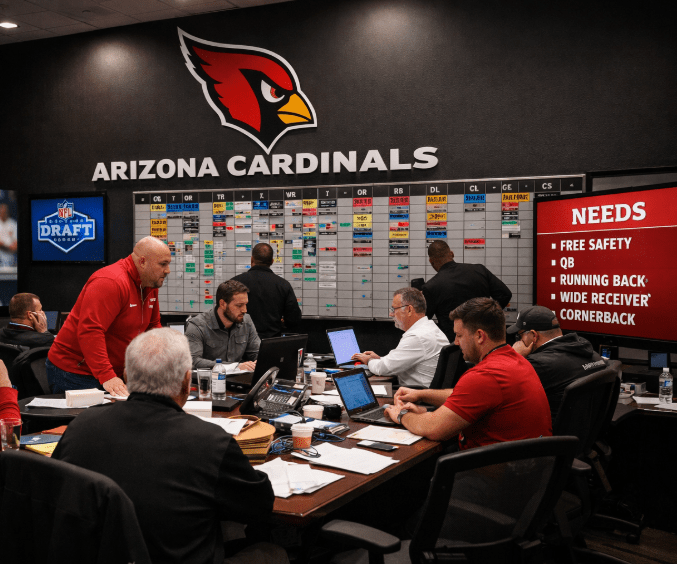

In the NFL, progress is rarely linear. Teams don’t simply rise, peak, and fall in neat cycles. Instead, they exist in a constant state of adjustment—plugging leaks, forecasting futures, and deciding when to chase the present versus when to protect tomorrow. For the Arizona Cardinals, this upcoming NFL Draft represents one of those defining moments: not a desperate rebuild, not a victory lap, but a calculated recalibration.
The foundation is there. A franchise quarterback still capable of special moments. A generational wide receiver in the early stages of stardom. Young contributors beginning to form an identity on both sides of the ball. Yet for all the optimism, the cracks are visible. Close games slipping away. Defensive lapses at critical moments. Offensive drives stalling when answers should be available.
This draft is about addressing those cracks—strategically, deliberately, and with an eye toward both immediate impact and long-term sustainability. Five positions stand out above the rest: free safety, quarterback, running back, wide receiver, and potentially cornerback. Each tells its own story about where the Cardinals are—and where they believe they’re headed.
The Free Safety Void: A Defense Without a True Anchor
Every strong NFL defense has a stabilizer on the back end. A player who doesn’t just react to plays, but anticipates them. Someone who sees the entire field, erases mistakes, and makes quarterbacks hesitate just long enough for chaos to unfold up front.
For Arizona, that stabilizing presence has been missing.
Garrett Williams entered the role with promise—versatility, toughness, and the confidence of a coaching staff that believed he could grow into the job. But as the season wore on, so did the inconsistencies. Poor angles in coverage. Late reactions to crossing routes. Miscommunication that led to explosive plays. It wasn’t a lack of effort—it was a lack of command.
Opposing offenses noticed.
Teams attacked the middle of the field with increasing confidence, forcing the Cardinals’ corners to play more conservatively and the linebackers to cover more ground than they should. The ripple effect was damaging. A defense that could hold its own for stretches suddenly became vulnerable in high-leverage moments.
Arizona doesn’t need another developmental safety. This is not a “sit and learn” role. This is a Day One starter requirement.
The Cardinals are expected to prioritize a free safety with:
- True sideline-to-sideline range
- High football IQ and communication skills
- Ball-hawking instincts
- The ability to disguise coverage and close quickly
Plugging this hole would do more than replace a struggling player—it would fundamentally reshape the defense. It would allow corners to play aggressively. It would free linebackers to attack downhill. It would give the pass rush an extra half-second to get home.
This pick is about restoring order to a defense that has too often felt reactive instead of authoritative.
The Quarterback of Tomorrow: Planning Beyond Kyler Murray
Kyler Murray remains one of the most dynamic quarterbacks in football. His arm talent, athleticism, and creativity are still rare commodities, and when he’s operating at full confidence, Arizona’s offense looks dangerous.
But the Cardinals are no longer in the phase where Kyler is simply “the future.” He’s the present—and the future now requires contingency.
Murray is entering a stage of his career where durability, long-term health, and offensive evolution matter more than raw explosiveness. That doesn’t mean decline is imminent—but smart franchises don’t wait for warning signs before preparing.
Arizona’s quarterback room lacks a true developmental option. A player who can:
- Learn the offense without pressure
- Absorb habits from Murray
- Step in competently if needed
- Potentially take over in 1–2 years
This isn’t about creating controversy. It’s about organizational discipline.
The ideal prospect is not a raw athlete who needs to be rebuilt, nor an aging veteran with limited upside. Instead, Arizona will likely target a quarterback with:
- Strong processing ability
- Calm pocket presence
- Accuracy over flash
- Leadership traits
Someone who can quietly grow behind Murray, gain trust in the locker room, and be ready if the franchise ever needs to pivot.
This pick signals maturity. A team thinking beyond headlines and short-term optics, prioritizing continuity over chaos.
Life After James Conner: Rebuilding the Backfield Identity
James Conner’s departure closes an important chapter in Arizona’s offense. He was more than a running back—he was a tone-setter. Physical, reliable, and unafraid of contact, Conner gave the Cardinals an edge during transitional seasons.
Now, that edge must be recreated.
Trey Benson has emerged as the clear lead back. His blend of size, acceleration, and downhill power gives Arizona a true RB1 moving forward. He’s the type of runner defenses must account for on every snap.
Behind him sits Kaytron Allen—a capable, tough runner who fits the system, but whose role remains undefined.
Arizona doesn’t need a replacement for Benson. They need competition.
With Conner gone, the RB2 spot is wide open, and the Cardinals want a back who can:
- Challenge Allen immediately
- Offer complementary skills
- Contribute in pass protection
- Catch the ball out of the backfield
In today’s NFL, running back committees are less about sharing carries and more about situational flexibility. A rookie who excels on third downs, thrives in space, or brings home-run ability could carve out meaningful snaps early.
This is about sustainability. Keeping Benson fresh. Preventing offensive stagnation. Giving defensive coordinators one more variable to account for.
The Cardinals don’t need a star here—but they do need a weapon.
More Than Marvin: Expanding the Receiving Core
Marvin Harrison Jr. is everything the Cardinals hoped he would be—and perhaps more. He’s already commanding attention from opposing defenses, forcing double teams, and redefining how Arizona structures its passing game.
Kaden Prather has shown flashes as a physical complement—strong at the catch point, willing to work the middle of the field. But beyond those two, consistency drops off sharply.
Marcus Burke was expected to solidify his role. Instead, struggles with separation, timing, and finishing plays have limited his impact. Opportunities have been there. Production has not followed.
That leaves Arizona with a clear need: another reliable receiving option.
Not necessarily a superstar—but someone who can:
- Win one-on-one matchups
- Stretch the field or dominate the slot
- Create yards after the catch
- Punish defenses that overcommit to Harrison
Adding a receiver here isn’t redundancy—it’s necessity. Elite wideouts thrive when defenses are forced to pick their poison. Harrison Jr. drawing coverage only matters if someone else can capitalize.
This pick is about offensive balance. About ensuring that Arizona’s passing game doesn’t become predictable or overly dependent on a single star.
The Luxury That Might Not Be: A Star Cornerback Falls
Every draft presents unexpected opportunities. Players slide. Boards break strangely. And sometimes, a franchise is forced to choose between need and undeniable talent.
If a star-studded cornerback prospect falls within reach, Arizona will face a fascinating decision.
The NFC West is loaded with receiver talent. Shutting down half the field remains one of the most valuable assets in football. Pairing a true lockdown corner with a new free safety could instantly transform the Cardinals’ secondary from vulnerable to dangerous.
This wouldn’t be a luxury pick—it would be a statement.
A statement that Arizona intends to:
- Match up with elite offenses
- Play aggressive, man-heavy schemes
- Dictate tempo defensively
Adding a cornerstone cornerback could accelerate the defensive rebuild dramatically, even if it means delaying another positional need.
The Bigger Picture: A Draft About Direction
This draft isn’t about one player saving the franchise.
It’s about alignment.
Aligning the defense with modern NFL demands. Aligning the offense with its young superstar receiver. Aligning the quarterback room with long-term reality. Aligning the roster with both today’s competitiveness and tomorrow’s uncertainty.
The Arizona Cardinals are no longer searching for an identity. They’re refining one.
If executed correctly, this draft won’t just fill holes—it will establish a roadmap. One that turns flashes into consistency. Potential into performance. And promise into progress.
In the desert, evolution is survival. And for Arizona, this draft may be the moment when survival finally turns into sustained success.