
Twelve months ago, the Arizona Cardinals were standing on the edge of something special.
An 11–6 regular season had reintroduced belief to the desert. A roster once dismissed as transitional had instead grown teeth, toughness, and identity. Kyler Murray was healthy and confident. The offense was creative, explosive, and resilient. The defense bent often but found ways to close. Most importantly, Arizona wasn’t just winning—they were winning close, the hallmark of a team that believed it belonged.
That belief carried them all the way to the NFC Championship Game.
And then, almost inexplicably, it vanished.
The following season told a very different story. One defined by frustration, squandered opportunities, and a steady unraveling that left the Cardinals staring at a 5–12 record and an empty postseason. From conference title contenders to draft lottery residents, Arizona’s regression was as jarring as it was comprehensive.
This wasn’t a team undone by one catastrophic injury or a sudden loss of leadership. It was death by a thousand cuts—late-game collapses, defensive breakdowns, and moments where execution failed just long enough to undo everything else.
The Cardinals didn’t fall off a cliff.
They slipped—slowly, painfully, and publicly.
The Weight of Expectations
Regression is often cruelest when expectations are highest.
Arizona entered the season no longer flying under the radar. After reaching the NFC Championship, they were circled on calendars, dissected on film, and treated as a legitimate threat within a loaded conference. Close wins from the year prior were no longer seen as resilience—they were labeled unsustainable.
Still, inside the building, confidence remained.
The roster returned largely intact. The offense promised continuity. The defense, though imperfect, was expected to take a step forward with veteran leadership and young talent gaining experience. The goal wasn’t simply to return to the playoffs—it was to finish the job.
Instead, the foundation cracked almost immediately.
A Defense in Freefall
If there is a single statistic that defines Arizona’s collapse, it lives on the defensive side of the ball.
By season’s end, the Cardinals ranked near the bottom of the league in:
- Total defense
- Points allowed
- Third-down defense
- Red-zone efficiency
- Explosive plays surrendered
This wasn’t a unit struggling in one area—it was failing across the board.
What made it even more puzzling was the personnel.
Budda Baker, the emotional and tactical leader of the defense, looked uncharacteristically hesitant. Still physical, still vocal, but often a step late. Plays he once erased turned into chain-moving gains. His leadership never wavered, but the impact plays that defined his reputation became increasingly rare.
Christian Wilkins, brought in to anchor the interior and disrupt pockets, battled inconsistency. There were flashes of dominance—moments where he collapsed the line and reminded everyone why he was a centerpiece—but they came too infrequently. Too often, quarterbacks stepped up cleanly, untouched, with time to exploit coverage breakdowns behind him.
Max Melton, tasked with growing into a larger role in the secondary, endured a brutal learning curve. Targeted relentlessly, he struggled with route recognition and recovery speed, particularly against veteran receivers who baited him into mistakes. Confidence waned as the season progressed, and opposing offenses smelled blood.
Collectively, the defense lacked cohesion.
Missed tackles turned short gains into explosive plays. Coverage busts extended drives that should have ended. And perhaps most damning, the Cardinals simply could not get off the field when it mattered most.
A Silver Lining Emerges
And yet, amid the defensive wreckage, two names quietly rose from the chaos.
Cody Simon became the heartbeat of the unit.
What began as a rotational role evolved into a breakout campaign defined by instinct, physicality, and relentless effort. Simon wasn’t flashy—but he was everywhere. Shooting gaps. Filling run lanes. Dropping into coverage with purpose. He played with urgency that the rest of the defense too often lacked.
Beside him, Owen Pappoe found his footing.
Once considered raw and situational, Pappoe’s speed and range began translating into tangible production. Together, Simon and Pappoe formed a linebacker duo that offered hope—proof that not everything on defense was broken beyond repair.
In a season dominated by collapse, their emergence stood as a reminder: development was still happening, even if results weren’t.
The Offense: Brilliant, but Not Immune
If the defense collapsed loudly, the offense unraveled more quietly.
Statistically, Arizona continued to impress. Yardage totals remained strong. Explosive plays still appeared weekly. Kyler Murray delivered some of the most efficient football of his career, navigating pressure and extending plays with poise.
But context matters.
The season began with a thunderclap that altered everything: Trey McBride’s absence for the first four games.
What initially surfaced as a minor off-field issue quickly escalated into a league investigation tied to gambling violations. While McBride was ultimately cleared of any intent to influence games, his involvement—however peripheral—cost him four crucial games and shook the locker room.
The timing couldn’t have been worse.
Without McBride, Arizona lost more than a tight end—they lost a security blanket. A chain-mover. A matchup nightmare. A safety valve for Murray when protection broke down.
The offense adjusted, but it never truly replaced him.
Early-season losses piled up, each one narrow, each one painful. Red-zone trips stalled. Third-down conversions slipped just out of reach. The margin for error vanished.
A Season of One-Score Nightmares
Perhaps the most haunting similarity between Arizona’s championship run and their collapse was this:
Almost everything came down to the wire.
Just like the year before, the Cardinals lived in close games. But where they once thrived, they now faltered.
A missed read here.
A dropped pass there.
A blown coverage with two minutes left.
Games Arizona once found ways to steal now slipped through their fingers.
Sometimes it was the offense—a mistimed throw, a failed fourth-down conversion, a drive-killing penalty. Other times it was the defense, surrendering long, methodical marches when all that was needed was one stop.
There were weeks where the Cardinals outgained opponents by wide margins and still lost. Weeks where Murray led late-game drives only to watch the defense give it back moments later.
It wasn’t bad football.
It was incomplete football.
The Mental Toll of Losing Close
Losing big is painful.
Losing close is corrosive.
As weeks passed, frustration crept in. Confidence eroded. Players pressed—trying to make hero plays instead of trusting assignments. Coaches grew conservative in moments that once demanded aggression.
The body language changed.
What once felt like resilience began to feel like inevitability. Late leads didn’t inspire confidence—they inspired dread. The belief that “we’ll figure it out” was replaced with “here we go again.”
That psychological shift mattered as much as any statistic.
The Cardinals weren’t being blown out. They were being undone—slowly, repeatedly, and in ways that linger long after the final whistle.
Leadership Under Fire
Leadership was tested across the roster.
Veterans like Budda Baker shouldered responsibility publicly, even as their own struggles mounted. Kyler Murray remained composed, refusing to deflect blame despite carrying a disproportionate burden. Coaches preached patience, accountability, and execution.
But leadership alone cannot compensate for structural flaws.
When a defense cannot communicate, no speech fixes it.
When assignments break down, no film session erases it.
Arizona’s leaders didn’t disappear—but they were forced to fight uphill against momentum that refused to turn.
How It Fell Apart
So how does a team go from 11–6 and an NFC Championship appearance to 5–12 and watching January football from home?
There is no single answer.
It was:
- A defense that regressed instead of matured
- Star players struggling simultaneously
- Early-season adversity magnified by close losses
- An offense missing its margin for error
- A team that couldn’t finish
Most of all, it was a reminder of how thin the line between contender and disappointment truly is in the NFL.
Ownership Response: Brad Pitt’s Resolve to Rebound
As the losses mounted and the playoff picture faded, attention inevitably turned upward—to ownership.
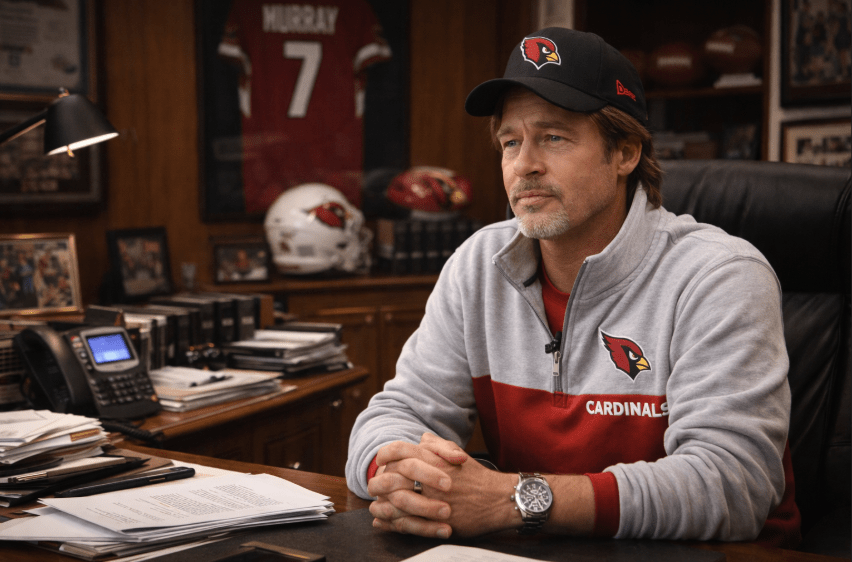
Brad Pitt, whose tenure as majority owner began with optimism and ambition, had never shied away from visibility. He was present during the highs of the NFC Championship run, vocal about building a culture rooted in accountability and long-term vision. This season, however, tested that vision in ways no press conference or preseason optimism could have predicted.
Sources around the organization describe Pitt as frustrated, but far from detached.
Rather than distancing himself amid the collapse, Pitt became more engaged. Internal meetings grew longer. Conversations expanded beyond weekly results and into structural evaluation—coaching alignment, roster construction philosophy, player development timelines, and the psychological toll of repeated close losses.
This wasn’t reactionary panic. It was recalibration.
Pitt understands the cruelty of the NFL’s margin for error. He also understands narrative—and how quickly it turns. One year removed from being praised as an owner presiding over a rising contender, he now faces questions about whether last season’s success was the ceiling rather than the foundation.
Privately, those questions have fueled him.
Ownership sources indicate Pitt has made it clear that this offseason will not be about cosmetic fixes or symbolic gestures. The expectation is a comprehensive rebound plan, centered on defensive accountability, depth development, and restoring confidence within the locker room.
He is believed to be heavily involved in discussions about:
- Reinforcing the defensive identity
- Evaluating leadership structures within position groups
- Supporting aggressive offseason roster moves
- Ensuring the coaching staff is fully aligned with player strengths
Perhaps most notably, Pitt has emphasized patience—but not complacency. The message has been consistent: regression is unacceptable, but so is overcorrection. The goal is not to tear down what worked, but to reinforce it so the foundation doesn’t crack again.
To Pitt, this season is not a referendum—it’s a warning.
A warning about how quickly windows close.
About how fragile momentum truly is.
And about how ownership sets the tone when adversity arrives.
Next season, expectations won’t disappear—but they will be reshaped. Less hype. More edge. A sharper understanding of what separates contenders from pretenders.
For Brad Pitt, the rebound isn’t about public image or headlines. It’s about proving that last year wasn’t a fluke—and that this year won’t define the franchise’s direction moving forward.