
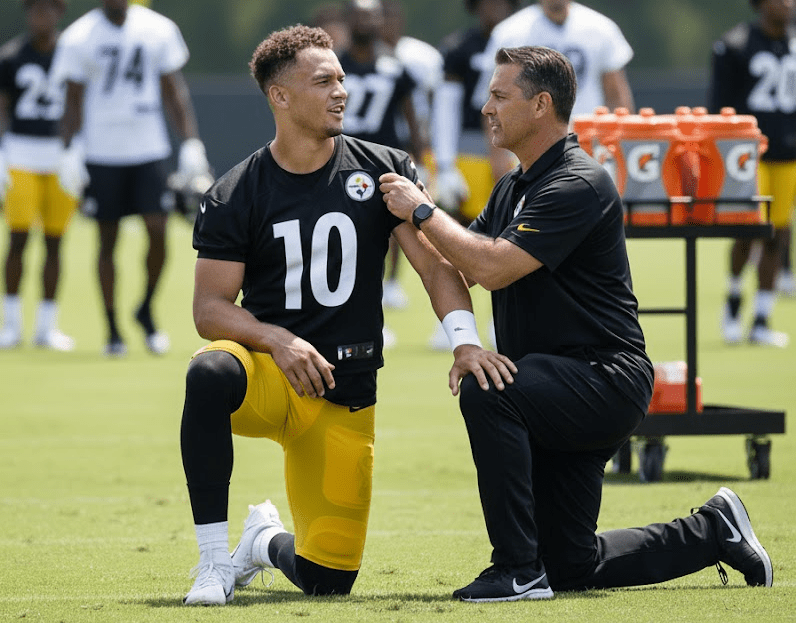

PITTSBURGH – Desmond Ridder is not just thinking about this season. He is thinking about a career.
As the regular season winds down and playoff talk intensifies around the league, the Steelers quarterback is focused on something far less flashy but every bit as important, which is taking care of his body, maximizing his potential, and ensuring that his career is built to last. In a league where durability and consistency separate the great from the forgotten, Ridder’s approach this late in the season shows a maturity beyond his years.
After signing his new two-year extension with Pittsburgh earlier this season, Ridder has continued to show growth on the field, but behind the scenes, the focus has been on his long-term development. According to league sources, Coach DK LaFleur and the Steelers have invested in upgrading Ridder’s personal trainer system, which is a move that reflects both trust in his future and a commitment to sustained excellence.
A Focus on Longevity
In the Premier Madden League, player development isn’t just about performance on game day. It’s about managing the small details that separate good teams from great ones. One of those details is the Trainer System, a unique mechanic designed to simulate real-life player growth and maintenance.
In essence, each player in the league is assigned a virtual trainer who determines how often they can receive upgrades and how much they can improve over the course of a season and the cycle as a whole. Trainers can be upgraded to allow for more frequent development opportunities and higher overall limits, reflecting the work ethic and conditioning investment that goes into becoming an elite player.
For Ridder and the Steelers, that means a faster, more consistent growth curve moving forward.
How the Trainer System Works
The Trainer System is simple in concept but crucial in execution. It determines how many upgrades a player can earn per season and how quickly those upgrades can be applied.
Here’s how it breaks down:
- Level 0 Trainer: 10 upgrades per season, free, upgrade window every rolling 48 hours.
- Level 1 Trainer: 15 upgrades per season, 20 points, upgrade window every 24 hours.
- Level 2 Trainer: 20 upgrades per season, 30 points, upgrade window every 24 hours.
- Level 3 Trainer: 25 upgrades per season, 40 points, upgrade window every 24 hours.
Each level must be purchased sequentially, meaning coaches need to plan ahead and invest wisely. Once purchased, the trainer stays with the player for the entire cycle, even if they are traded.
The payoff is massive. A player with a Level 1 or Level 2 trainer can improve at nearly twice the rate of one with a Level 0 trainer. For quarterbacks like Ridder, that means refining accuracy, awareness, and decision-making at a much faster pace than their peers.
League Leaders in Player Investment
As it stands, only one player in the entire league has reached a Level 2 trainer: Anthony Richardson of the Indianapolis Colts, coached by Greeny. Richardson’s trainer gives him 20 upgrades per season, which is a significant advantage in maintaining top-tier performance.
Behind Richardson is a small group of players with Level 1 trainers, which is a sign of both strategic foresight and a commitment to long-term team building. Among those are:
Steelers (Coach DK LaFleur)
- QB Desmond Ridder
Panthers (Coach JT)
- WR Jimmy Horn
- WR Tetairoa McMillan
- DT Tershawn Wharton
- CB Jaycee Horn
- LT Ikem Ekwonu
This select list represents the league’s most proactive franchises when it comes to maximizing player potential. Each of these players can be upgraded 15 times a season and are eligible for an upgrade every calendar day instead of every 48 hours.
DK LaFleur’s Approach to Player Development
For DK LaFleur, the decision to invest in Desmond Ridder’s long-term development was a no-brainer. Since taking over the Steelers in Week 4, LaFleur has built his program on preparation, discipline, and steady improvement and not overnight results.
“Desmond’s earned every bit of it,” LaFleur said when asked about the investment. “He’s handled everything we’ve thrown at him this season. From stepping into the starting role midseason to leading this offense, he’s taken ownership of the process. You want to reward players like that with every tool possible to succeed.”
That mindset has been evident on the field. Ridder has shown tremendous growth under LaFleur’s leadership, throwing 37 touchdowns with a 72 percent completion rate and a 127.2 NFL passer rating through 10 games. Beyond the numbers, it’s his confidence, command, and control of the offense that stand out.
By pairing him with a dedicated Level 1 trainer, Pittsburgh is signaling that they see Ridder not just as a short-term answer but as the quarterback of the future.
Building for the Long Haul
The Steelers’ investment in Ridder’s development reflects a broader philosophy, and one that prioritizes sustainability and structure over short-term gain.
“When you look at the great organizations in this league,” LaFleur said, “they’re not just reacting to what happens this week. They’re planning for what’s next year, and the year after that. That’s the kind of foundation we’re trying to build here.”
This is not just about a single player’s growth, but about cultivating a system that supports continuous improvement across the roster. For a team that has added key young pieces like Nate Carter, Alec Pierce, and Lewis Cine, ensuring that each of them can maximize their potential over the course of multiple seasons is essential.
The Bigger Picture
As the league evolves, the Trainer System has become one of the most important long-term tools for maintaining competitive balance. Coaches who plan ahead and invest early often find themselves with rosters that age gracefully, while those who neglect the system can fall behind quickly.
For the Steelers, this is just one more example of how LaFleur is being intentional about every move he makes. He’s not just focused on this playoff push, but he’s building an infrastructure that can sustain success well beyond the current season as well.
And for Desmond Ridder, that means a chance to not only continue his career resurgence but to elevate it to another level. With the right support, the right system, and the right mindset, Pittsburgh’s quarterback might just be the next great long-term story in the Premier Madden League.
As LaFleur put it best, “The goal isn’t just to win games this season. The goal is to build something that lasts as well.”
– Forged In Steel Times